Legitimacy
Where does the right to rule come from?
The source of political authority: transcendence, tradition, contract, consent or collective will.
Transcendent · Traditional ↔ Rational · ContractualIndividual consent ↔ Collective will
An atlas of political convictions
Beyond the Cartesian plane: six layers, thirteen dimensions, a genealogical tree of sixty lineages and a philosophical reading of what you truly believe.
Proem
The Political Compass and its derivatives remain the best starting point for comparing political positions. But their axes — economic, authority and sometimes cultural — are shallow and rarely independent. They blend dimensions that ought to be kept apart and leave out the deeper layers: the source of legitimacy, social ontology, epistemology, the preferred institutional scale.
Questions that force contemporary dichotomies and assume the state as the only arena produce low-resolution classifications. ORDVS was born to distinguish what one desires from the way one means to legitimise it — and to treat hybrid positions, meta-positions and internal tensions as information, not noise.
From plane to atlas
Architecture
Each layer interrogates a distinct foundation of political conviction. Together they form a map no Cartesian plane can hold.
Where does the right to rule come from?
The source of political authority: transcendence, tradition, contract, consent or collective will.
Who is the subject of politics?
The primary political subject — individual, family, community, nation, class — and the human nature it assumes.
What is desired, and how do we get there?
Separates the substantive preference (the desired arrangement) from its character (voluntary or imposed).
What morality sustains our common life?
The relation to tradition and progress, and the degree of moral pluralism the public order admits.
At what size, with how much power?
The preferred institutional scale — from local to universal — and the reach of coercive power.
How do we know what is just?
Where relevant knowledge resides and which criteria justify a political choice.
Procedure
It begins with premises, branches wherever there is ambiguity and ends in a reading in plain language.
Thirty-one high-level questions — scales and choices of up to six options — on the foundations of authority, the subject and knowledge.
Your premises open the three nearest houses. Once you choose a door, each fork separates neighbouring traditions until one of sixty lineages.
A multidimensional profile with an interpretation of each layer, coherences, inconsistencies, kindred families, meta-positions and alternative scenarios.
The result
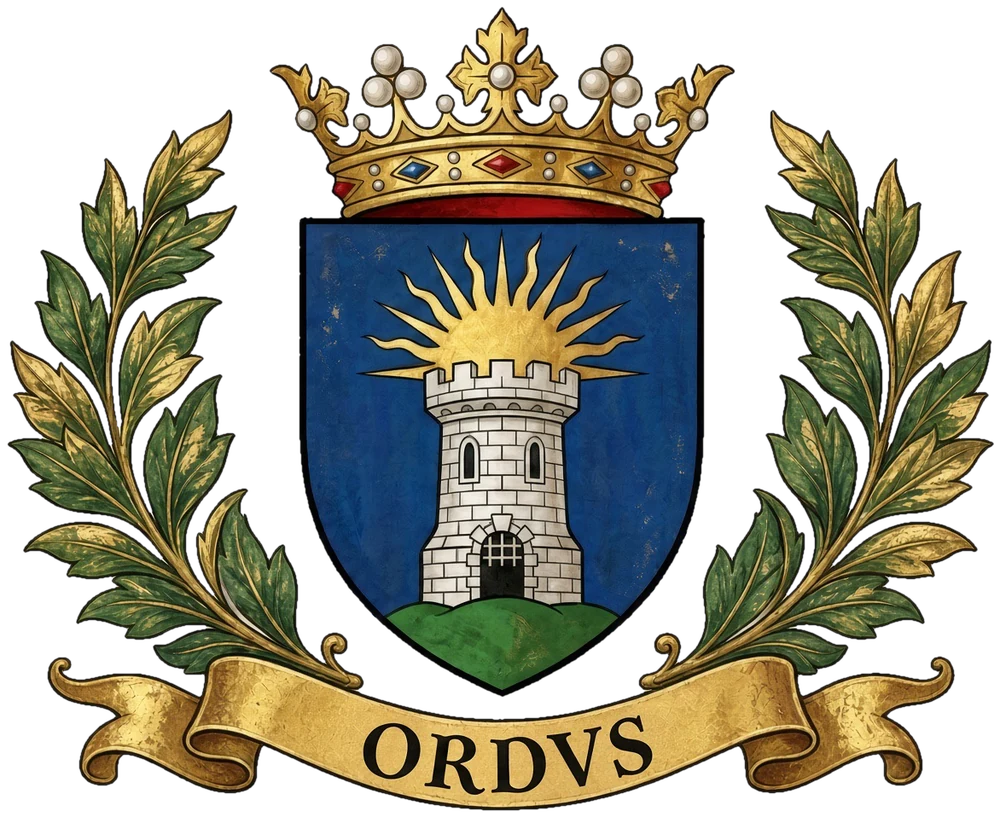
At the end you receive your profile in thirteen rays, a coat of arms drawn from your convictions and a reading of each layer.
Coat of arms of a sample profile
Kindred families
“Subsidiarist traditionalist of voluntary method” — a sample synthetic reading.
Gallery of flags
From legitimism to anarcho-communism, from theocracy to panarchism: every tradition is placed on the same thirteen dimensions — and compared with you.
About fifteen minutes. No sign-up. Your result stays with you.
Take the assessment